
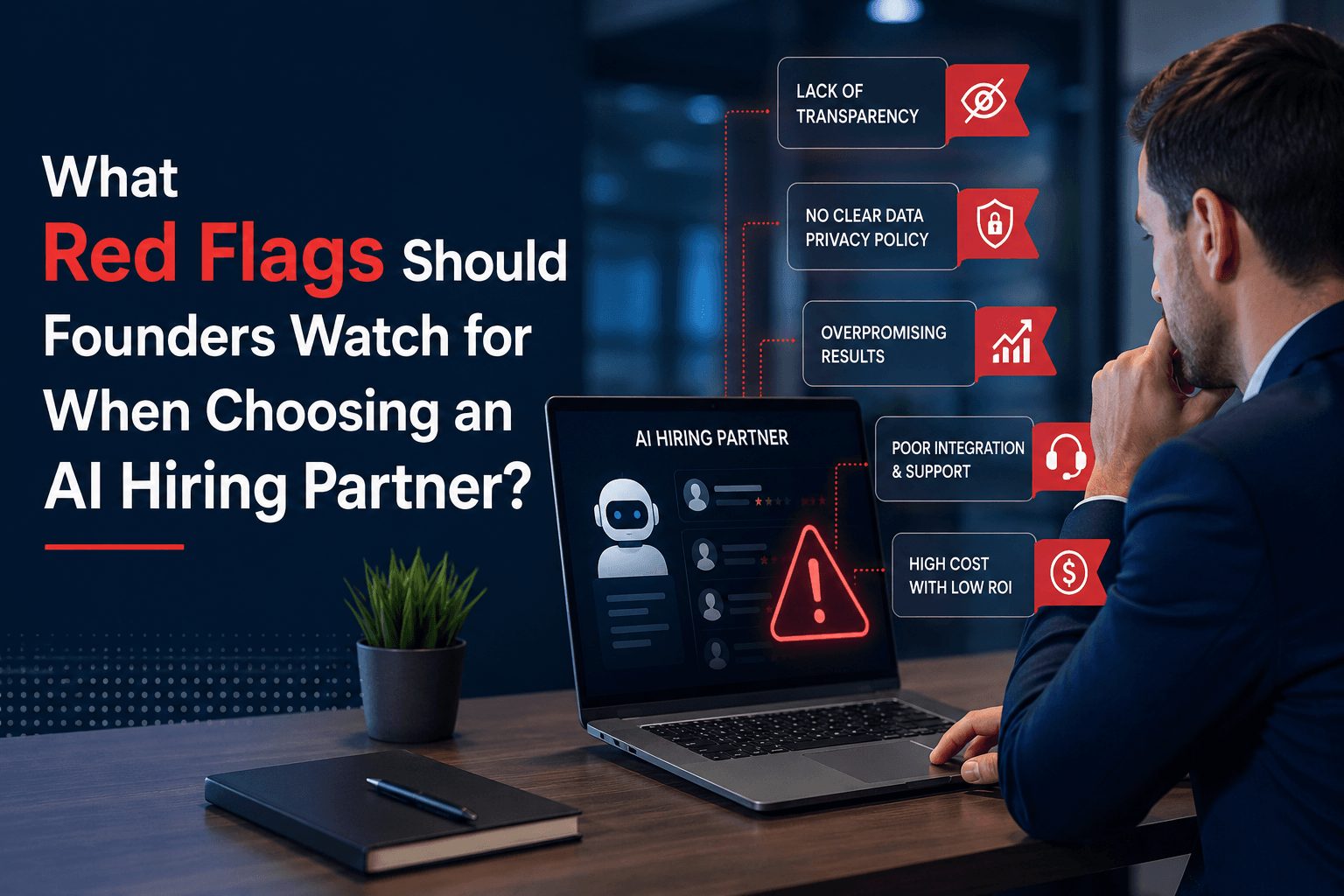
The clearest warning signs when evaluating an AI hiring partner are a vague explanation of how candidates are actually vetted, a “we do everything” pitch instead of real AI/ML specialization, resume dumps instead of curated shortlists, no concrete replacement guarantee, murky compliance handling for cross-border hires, and a sourcing process too slow or manual to keep pace with how fast AI talent moves off the market. Any one of these should make a founder slow down before signing. Together, they’re usually a sign the partnership will cost more time and money than it saves.
Founders don’t always catch these signals early, because most AI hiring partners sound reassuring in the pitch meeting. Everyone claims to vet rigorously, move fast, and stand behind their placements the differences only become obvious once a shortlist actually lands, a contract gets read line by line, or a first hire quietly underperforms three weeks in. That delay is exactly why it pays to interrogate the specifics upfront rather than take the pitch at face value. Here’s what to actually watch for.
Red Flag #1: They Can’t Explain Their Vetting Process in Specific Terms
If you ask how a partner verifies technical skill and the answer stays vague “we review resumes and do a call” that’s a problem, especially for AI roles. Traditional interviews are struggling to catch capability gaps in the first place: recent data shows 38.5% of tech candidates are now using AI tools to cheat during interviews, often undetected by standard interviewers. A partner without a structured, skill-specific evaluation (ideally combining automated screening with human technical review across the exact stack you’re hiring for PyTorch, LangChain, RAG pipelines, whatever applies) is passing that risk straight to you. Ask what happens between “candidate applies” and “candidate reaches your inbox.” If the answer is thin, that’s the red flag.
Red Flag #2: They Claim to Be Great at Every Role and Every Industry
A partner who says they’re equally strong at hiring salespeople, customer support, and AI engineers is usually telling you they don’t specialize in any of them well. AI hiring in particular requires understanding what a role like an MLOps engineer or a RAG engineer actually does day to day something a generalist staffing firm without ML-specific screening infrastructure typically can’t assess. Specialization isn’t a marketing detail; it’s the difference between a shortlist of people who can talk about AI and a shortlist of people who can ship it.
Red Flag #3: You Get a Pile of Resumes Instead of a Curated Shortlist
A strong hiring partner sends you a small number of candidates with context why each one fits, where the tradeoffs are, what to probe in the interview. A weak one sends volume and lets you do the filtering yourself, which defeats the entire point of paying for the service. If a “shortlist” looks more like a resume database export, you’re doing the recruiting work and paying someone else for the privilege.
Red Flag #4: Pricing, Guarantees, and Replacement Terms Stay Vague
This is one of the most common red flags advisors point to: partners who get uncomfortable when asked directly about fees, replacement windows, or what happens if a hire doesn’t work out within the first few months. A serious hiring partner should be able to state, in one sentence, what happens if the person you hire isn’t a fit whether that’s a defined replacement guarantee, a lifetime replacement clause for contract roles, or a straightforward exit clause with no penalty. If that answer requires a follow-up call with someone “from legal,” treat it as a warning sign, not a formality.
Red Flag #5: They’re Vague About Compliance, Payroll, and Worker Classification
This matters most when hiring across borders, which is increasingly the default for AI teams pulling from talent pools in India, Eastern Europe, or Latin America. A partner who can’t clearly explain how they handle Employer of Record responsibilities, local compliance, and payroll is quietly leaving that risk on your desk. Founders rarely think about this until an audit, a tax question, or a dispute forces the issue by which point it’s an expensive problem to fix rather than a checkbox during the sales call.
Red Flag #6: The Process Is Too Slow to Compete for Real Talent
The average time-to-hire for a senior, specialized AI engineer has stretched to 90–120 days in many markets and a slow hiring process doesn’t just cost time, it actively selects for whichever candidates are willing to wait the longest, not the strongest ones. If a hiring partner’s process still runs on manual sourcing, generic job board postings, and multi-week turnaround for a first shortlist, they’re operating on a timeline that guarantees you lose the best candidates to companies that move faster.
Read More: AI 3D Generators
What Founders Should Actually Look For
None of this means every hiring partner is a bad bet it means the good ones are identifiable by specific, checkable answers rather than reassurance. Uplers built its model directly around closing these gaps: a defined two-stage vetting process combining AI screening with human technical validation across 100+ specific skill sets, a 48-hour shortlist turnaround instead of a multi-week search, a 90-day replacement guarantee on full-time hires (lifetime on contract roles), and direct Employer of Record handling for cross-border hires rather than leaving compliance as an afterthought.
The point isn’t that any one partner is perfect by default it’s that a founder evaluating an AI hiring partner in 2026 has every right to ask these six questions directly, get specific answers, and walk away from anyone who can’t provide them. The partners worth signing with are the ones who welcome the scrutiny rather than deflecting it, and who can point to a defined process, a real guarantee, and a track record instead of a general assurance that “it usually works out.” A quick reference check with a past client, a direct question about replacement rates, and a plain-language read of the contract’s exit terms will surface most of these red flags before a single candidate is even submitted and that diligence up front is far cheaper than discovering the answer after a bad hire is already three months into the job.