
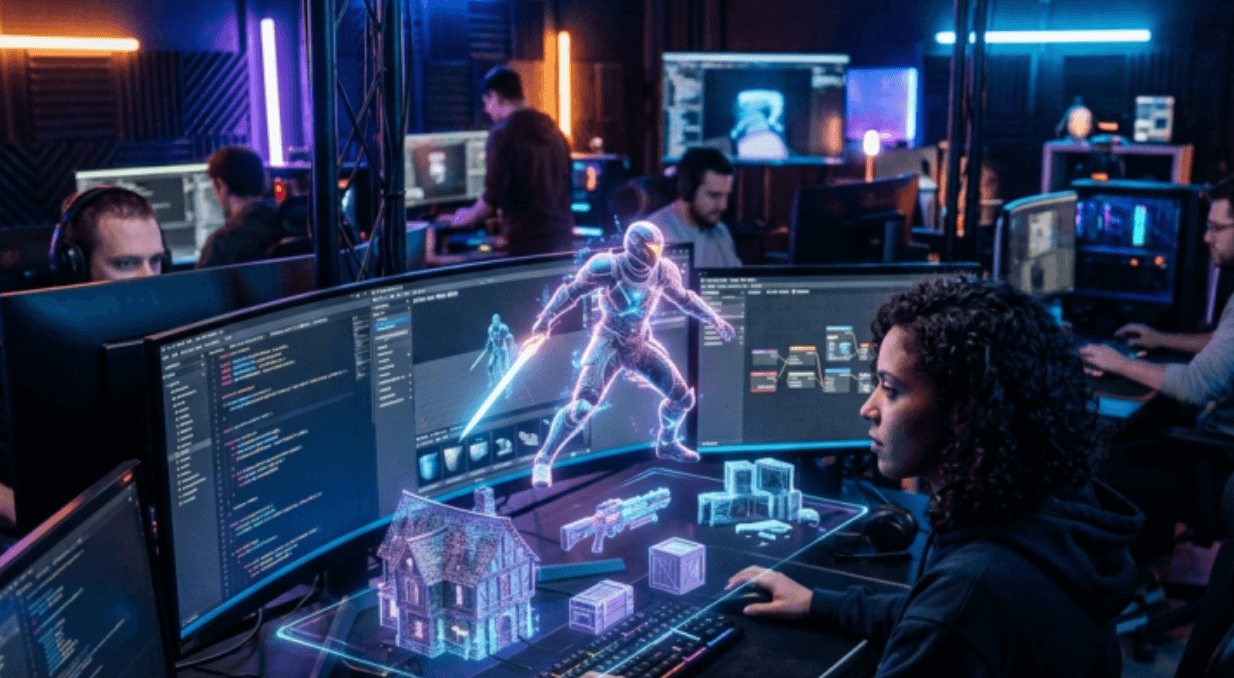
The digital entertainment industry is currently experiencing a massive structural shift in how visual assets are produced. Historically, creating high-fidelity environments and character models required a massive labor force of technical artists, riggers, and animators. Generating a single production-ready prop could easily consume days of intensive manual labor. Today, this traditional pipeline is being completely rewritten by the introduction of automated generation technologies.
At the very center of this transformation are advanced platforms like Neural4D, which are enabling studios to bypass the most tedious aspects of environmental design and character modeling by converting simple 2D reference images into fully textured, geometry-optimized digital objects.
This shift in production methodology is significantly reducing the overhead required to populate massive open-world environments. The academic and technical foundation driving this change is profound. Neural4D was jointly developed by researchers from Nanjing University, DreamTech, Oxford University, and Fudan University. By utilizing their proprietary Spatial Sparse Attention (SSA) mechanisms and the Direct3D-S2 architecture, the platform serves as an incredibly capable AI 3D model generator software that integrates directly into modern engine pipelines. This allows both independent developers and major AAA studios to dramatically reduce their time-to-market while simultaneously increasing the visual density of their virtual worlds.
Read More: Online AI Photo Editing Made Simple with Vidmud
The Bottleneck of Traditional Asset Creation
To fully grasp the magnitude of this disruption, one must understand the traditional constraints of game development. Video games have grown exponentially in scale over the past decade. A standard open-world title now requires thousands of unique environmental props, ranging from detailed architectural elements to scattered debris and vegetation. Each of these assets typically passes through a rigorous multi-step pipeline.
- Concept Art and Referencing: Artists create 2D sketches or gather photographic references for the required objects.
- High-Poly Sculpting: Technical artists build an extremely detailed version of the asset using digital sculpting software.
- Retopology: The high-poly model must be manually simplified into a lower polygon count mesh that can run smoothly in real-time engines.
- UV Unwrapping and Texturing: The surface of the 3D object is flattened out so that textures, normal maps, and roughness maps can be painted onto it.
This process is fundamentally difficult to scale. When a project requires ten thousand unique assets, the financial and temporal costs become staggering. The industry has reached a point where graphical ambition is actively restricted by human labor capacities.
Automating the Production Pipeline
The integration of deep learning into spatial data processing is actively solving this labor crisis. Modern generative models have been trained on vast datasets of physical objects, learning to infer depth, volumetric structure, and material properties from flat visual inputs. When a developer uploads a piece of concept art into an advanced generation platform, the underlying algorithm analyzes the shading and perspective to extrapolate a complete three-dimensional mesh in minutes.
Key Advantages of Automated Generation
The adoption of this technology offers several distinct advantages that are fundamentally altering project management strategies across the industry:
- Rapid Prototyping: Game designers can rapidly block out levels using fully textured placeholder assets rather than generic gray boxes, providing a much clearer sense of the final visual direction during early testing phases.
- Massive Cost Reductions: By outsourcing the heavy lifting of background asset creation to machine learning algorithms, studios can reallocate their human talent toward hero assets, complex character animations, and intricate level design.
- Consistent Topology: Advanced systems enforce strict mathematical rules during mesh generation, ensuring that all created assets share a unified polygon structure and texture resolution that optimizes rendering performance.
“The true value of automated asset generation is not in replacing the artist, but in eliminating the friction of production. When technical limitations are removed, studios can focus entirely on creative iteration and world-building.”
The Impact on Independent Developers and Modding Communities
While massive corporations benefit from the sheer volume of assets they can now produce, independent developers are perhaps the most significant beneficiaries of this technological leap. Historically, small teams of five to ten people could not realistically compete with the environmental density of games produced by studios employing hundreds of artists.
Today, a small indie team can generate an entire library of unique environmental props over a single weekend. This democratization of high-end graphics allows independent studios to punch far above their weight class, delivering visually stunning experiences that rival much larger productions. The barrier to entry for creating expansive, highly detailed digital worlds has effectively been dismantled.
Furthermore, this technology is empowering the modding and hobbyist communities. Dedicated fans can now easily translate their own artwork or real-world photographs into usable game assets. Platforms dedicated to open-source collaboration, such as the DIY3D model sharing platform, are experiencing a surge in user-generated content as the technical hurdles of 3D modeling are lowered. These communities serve as massive repositories of creative work, where individuals can find, share, and modify assets for their own non-commercial projects, fostering a vibrant ecosystem of continuous digital creation.
Adapting to the New Standard
As with any major technological shift, integration requires careful planning. Studios cannot simply plug a new algorithm into their existing pipelines and expect perfect results immediately. There are specific technical requirements that must be met to ensure that generated assets function correctly within a larger game ecosystem.
The most pressing concern is engine compatibility. Generated assets must export cleanly into industry-standard formats that are immediately readable by engines like Unreal and Unity. The material nodes must map correctly to the engine’s physically based rendering (PBR) systems, ensuring that light interacts with the surfaces accurately.
Additionally, optimization remains a critical priority. While a generated mesh might look beautiful, it must also be lightweight enough to render sixty times a second without causing performance stuttering. Leading platforms address this by offering aggressive retopology settings, allowing developers to dictate the exact polygon budget for any given object before it is exported.
The integration of machine learning into 3D production pipelines is no longer a theoretical future; it is the current reality of the digital entertainment industry. The studios that actively adopt these tools are discovering entirely new workflows that prioritize creative direction over tedious manual labor.
By embracing automated asset generation, developers are freeing themselves from the historical constraints of production timelines, allowing them to focus on what truly matters: crafting deeply engaging, expansive, and visually spectacular interactive experiences. The rules of game development have permanently changed, and the creative possibilities are expanding at an unprecedented rate.


One thought on “The Rise of AI 3D Generators: How Automated Asset Creation is Disrupting Game Development”