
Causes, Diagnosis & Fixes for Passenger Cars and Light SUVs
Last updated: 20 May 2026
Note: This guide is written for passenger cars and light SUVs in the UK and USA. Tread depth limits and alignment recommendations may differ in your country — drivers in Pakistan, India, Australia and other regions should check with their local road authority or a certified tyre specialist.
Introduction
Your tyres don’t wear randomly. They wear in patterns — and every pattern is a message. Most drivers notice the wear, feel the cost, and book a replacement. But they never find out why it happened, which means it happens again. Faster. To the new set. The fix isn’t always expensive, but identifying the right fix requires knowing which pattern you’re dealing with first.
Uneven tyre wear refers to tread erosion that occurs faster in specific areas of the tyre rather than evenly across the full contact patch. It almost always signals an underlying mechanical or maintenance issue — such as incorrect tyre pressure, wheel misalignment, or worn suspension components — rather than a fault with the tyre itself.
What Is Uneven Tyre Wear?
A new tyre has roughly 8mm of tread depth. Under normal conditions, it wears gradually and evenly across the central three-quarters of its surface, giving 20,000 to 40,000 miles of life — sometimes more with premium compounds from brands like Michelin or Continental. Uneven wear is different: one section degrades significantly faster, and the pattern that forms points directly to a specific root cause.
Tyre wear is a symptom, not the problem itself.
Legal Tread Depth Limits
UK:
- Legal minimum: 1.6mm across the central three-quarters of the tread, around the full circumference.
- Safety recommendation (TyreSafe / RoSPA): Replace at 3mm — performance in wet conditions drops significantly before the legal limit is reached.
- Penalty for illegal tread: £2,500 fine per tyre + 3 penalty points.
USA:
- Federal minimum: 2/32 inch (~1.6mm) — consistent with UK law.
- Safety recommendation (NHTSA / Consumer Reports): Replace at 4/32 inch (~3.2mm) for adequate wet-weather performance.
- State variation: Some states (e.g. California) have additional inspection rules. Check your state DMV for local requirements.
- Note: No federal fine structure for tyre defects; enforcement is typically via vehicle inspection failure or post-accident liability.
[Key Stat] According to TyreSafe’s 2023 survey, over 6 million tyres on UK roads carry illegal tread depth each year. Source: TyreSafe Annual Survey 2023 — tyresafe.org/research
The 5 Tyre Wear Patterns and What Each One Means
Run your hand across the tread. Look at the edges versus the centre. Check whether the wear feels wavy or whether the tread blocks feel smooth on one side and sharp on the other. Your diagnosis starts here.
[Visual Note] Diagrams showing each wear pattern are recommended at this point in the published version. See companion visual resource or tyre manufacturer’s pattern guide.
1. Centre Tread Wear
What it looks like: The middle strip of tread is significantly more worn than the outer shoulders. The tyre looks ‘crowned’ when viewed from above.
What it means: Overinflation. An overinflated tyre balloons slightly, pushing the centre of the tread down harder onto the road while the edges barely touch.
Fix: Correct PSI immediately. The correct pressure is on the sticker inside your driver’s door jamb — NOT on the tyre sidewall (that figure is the maximum, not the operating pressure).
2. Both-Edges (Shoulder) Wear
What it looks like: Both the inner and outer edges wear faster than the centre. The middle looks relatively healthy; the shoulders look scraped.
What it means: Underinflation. A soft tyre deforms under load, pushing the edges onto the road and lifting the centre.
Fix: Correct PSI. According to TyreSafe, over 50% of UK tyres are underinflated — and underinflation wastes an estimated £1 billion in fuel annually (source: TyreSafe — tyresafe.org).
3. One-Edge (Inner or Outer) Wear — Camber Wear
What it looks like: Only one side is worn: either the inner or outer edge is significantly more degraded.
What it means: Camber misalignment — the tyre is tilting inward (negative camber) or outward (positive camber). Can result from hitting a kerb or pothole, worn suspension, or alignment drift.
Fix: Professional four-wheel alignment check + suspension inspection. Camber wear and toe wear are related but distinct — both need checking.
4. Cupping (or Scalloped Wear)
What it looks like: A wavy, dipped pattern on the tread surface — like small cups pressed into the rubber at irregular intervals. Often accompanied by vibration or thumping at speed.
What it means: Worn shock absorbers or struts, or out-of-balance wheels. When a shock absorber loses damping ability, the wheel bounces and each bounce scrapes a divot.
Fix: Suspension inspection first — new tyres on worn shocks will cup again within a few thousand miles. Also check wheel balance.
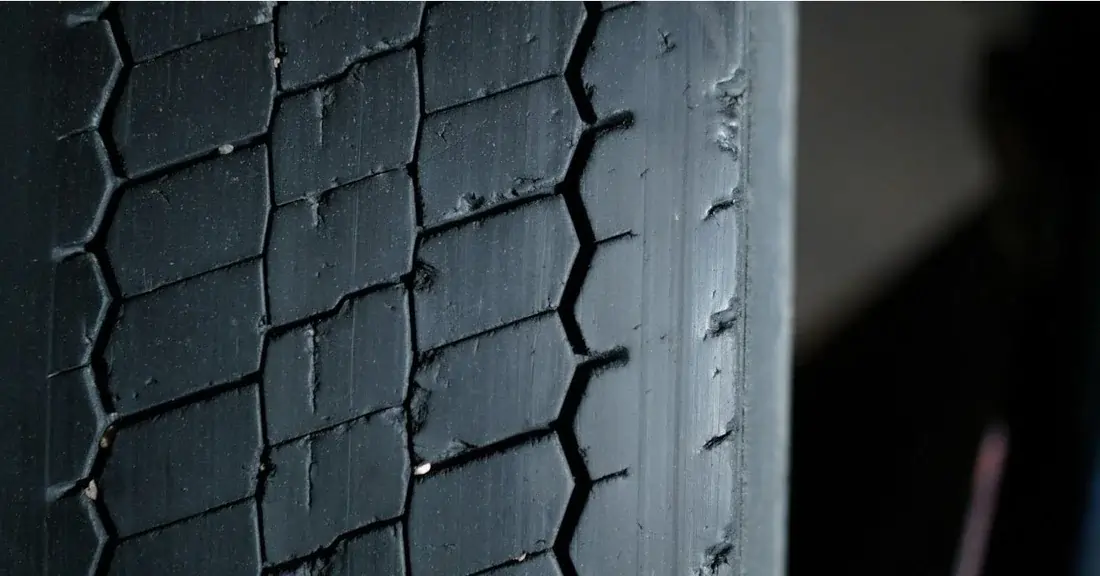
5. Feathering (or Heel-Toe Wear)
What it looks like: Each tread block wears unevenly across its width. Running your fingers across the tread, one side of each block feels smooth and rounded; the other side feels sharp. Resembles a row of angled wedges.
What it means: Toe misalignment. The tyre drags slightly sideways across the road with every rotation instead of rolling straight, rounding off one edge and sharpening the other.
Fix: Precision four-wheel alignment. Feathering is quiet — it usually causes no obvious pulling or vibration early on, which is why it’s often caught only when wear is already severe.
Quick Comparison: Wear Patterns at a Glance
| Pattern | What You See | Root Cause | Primary Fix |
| Centre wear | Middle strip worn | Overinflation | Correct tyre pressure |
| Both-edge wear | Both shoulders worn | Underinflation | Correct tyre pressure |
| One-edge wear | Inner or outer edge worn | Camber misalignment | Wheel alignment + suspension check |
| Cupping/scalloping | Wavy, dipped tread | Worn shocks/struts or imbalance | Suspension inspection + balancing |
| Feathering | Angled tread blocks | Toe misalignment | Precision wheel alignment |
[Key Stat] According to DVSA data analysed in 2024, over 2 million MOT failures annually result from tyre defects — many the end result of undetected wear patterns that progressed over months. Source: DVSA MOT data — gov.uk/government/organisations/driver-and-vehicle-standards-agency
What Causes Premature Tyre Wear?
Five main factors cause tyres to wear faster than they should. They often work in combination.
1. Incorrect Tyre Pressure
The single most common and most preventable cause. A tyre running just 0.3 bar below its recommended pressure wears its shoulders measurably faster than a correctly inflated example. Most TPMS systems only trigger a warning at 25% below recommended pressure — by which point wear has been accelerating for weeks or months. Check manually, monthly, with a gauge.
Note: Tyre pressure is widely cited as the leading single factor in premature wear by TyreSafe and the British Tyre Manufacturers Association. Misalignment is frequently underdiagnosed because early symptoms are invisible to the driver. (Source: BTMA Industry Position Paper 2022 — btma.org.uk)
2. Wheel Misalignment
Alignment refers to the angles at which your tyres meet the road. Even small deviations — a single degree off — cause the tyre to scrub rather than roll, generating friction and heat. A single pothole can knock alignment out, as can a kerb strike or gradual wear of suspension bushings. Annual alignment checks are the standard recommendation; also check after any significant impact.
3. Worn Suspension Components
Shock absorbers, struts, control arm bushings, and ball joints. When these wear out, the wheel moves in ways it shouldn’t — bouncing, tilting, or shifting under load. Suspension wear is insidious: by the time you feel it in the ride, the tyres have often been suffering for thousands of miles.
4. Driving Style
Hard braking, sharp acceleration, and aggressive cornering all generate heat and friction at the contact patch. Urban stop-start driving is harder on tyres than steady motorway or highway cruising. A driver with smooth, anticipatory technique can extend tyre life by 20–30% compared to someone with aggressive habits — on the same car, with the same tyres.
5. EV and Heavy Vehicle Loading
Electric vehicles wear tyres 20–30% faster than equivalent petrol/gasoline cars, due to instant torque delivery and the additional weight of the battery pack. Many EV drivers replace tyres well ahead of expected mileage without understanding why. EV-specific compounds (such as Michelin e-Primacy or Goodyear ElectricDrive) are engineered for this load profile and often outlast standard tyres on EVs considerably. If you drive an EV, factor in shorter replacement intervals from the start.
How to Fix Uneven Tyre Wear?
Electric vehicle drivers should rotate tyres every 5,000 miles instead of the standard 6,000–8,000. From the very first set, consider EV-specific tyres — compounds like Michelin e-Primacy or Goodyear ElectricDrive handle the extra weight and instant torque far better than standard tyres.
- Identify your wear pattern using the pattern guide above.
- Correct tyre pressure if you have centre or shoulder wear.
- Book a wheel alignment check for single-edge or feathering wear.
- Have suspension components (shocks, struts, bushings) inspected for cupping.
- Balance all four wheels if cupping is present alongside vibration.
- Replace severely worn tyres — worn tread cannot be reversed.
Pressure-related wear:
Fix immediately — correct the PSI, check monthly, do not rely on TPMS alone. The right pressure is on the driver’s door jamb sticker.
Alignment-related wear (camber, feathering, one-edge):
Requires a professional four-wheel alignment check. Typical cost: £40–£80 at an independent specialist or franchise (UK: Kwik Fit, ATS Euromaster; USA: Firestone, Pep Boys, local tyre shops).
For readers in other regions: visit any certified tyre service centre and ask for a four-wheel alignment with a printed before/after report.
General Alignment Cost Note: Outside the UK and USA, costs will vary. Always ask your local tyre shop for a printed before-and-after alignment report — this confirms the work was actually done and shows exactly what was corrected.
Suspension-related wear (cupping, scalloped patterns):
A technician will inspect shock absorbers, struts, control arm bushings, and ball joints. Replacing worn shocks typically costs £150–£350 per axle including parts and labour (UK pricing). USA pricing varies by region and vehicle — expect $180–$450 per axle at an independent shop.
When to replace the tyre:
Worn tread cannot be reversed. If any section has reached 3mm (UK/global safety standard) or 4/32″ (USA safety standard), replace the tyre before booking alignment or suspension work — then have the mechanical work done before fitting new rubber.
How to Prevent Tyre Wear Before It Starts
Prevention is cheaper than replacement. These four habits matter most.
Check tyre pressure monthly
Cold, morning pressure check — use the door jamb PSI, not the tyre sidewall maximum. Two minutes. Tie it to the first of every month.
Seasonal note: cold temperatures cause pressure to drop — roughly 1 PSI per 10°F (5.5°C) fall. UK drivers should recheck in October/November at the first cold snap.
USA Seasonal Pressure Tip: USA drivers in cold-weather states (Minnesota, Michigan, Colorado etc.) should recheck pressure every October and again in January — winter temperature drops can reduce pressure by 4–6 PSI overnight without any leak.
Rotate tyres every 6,000–8,000 miles (approx. 10,000–13,000 km)
Front tyres on front-wheel-drive cars carry steering, braking, and power delivery simultaneously — they wear faster. Rotation balances wear across all four. Book alongside an oil change.
Annual wheel alignment check
Or immediately after hitting a significant pothole, kerb, or if the car pulls to one side. Catches drift before it becomes a visible pattern.
Have suspension checked if the ride changes
A noticeably bumpier ride, unusual noises over speed bumps, or the car feeling less planted in corners are early signals. Catching worn shocks early saves both tyres and suspension parts.
20p coin test (UK): Insert a 20p into the tread groove. If the outer band is visible, you’re approaching the 3mm mark. At 1.6mm, the coin’s inner ring sits flush with the tread — legal minimum.
Quarter test (USA): Insert a US quarter upside down into the tread. If you can see the top of Washington’s head, you’re at or below 4/32″ — replace the tyre. Use a penny for the 2/32″ (legal minimum) check.
Frequently Asked Questions
Q: What’s the most common cause of uneven tyre wear?
A: Incorrect tyre pressure is the most common cause. Underinflation wears both edges; overinflation wears the centre. Wheel misalignment is the second most frequent cause and produces single-edge or feathering patterns.
Q: How do I know if my tyres need balancing or alignment?
A: Vibration through the steering wheel or seat usually points to wheel balance. A car that pulls to one side, or tyres with one-edge or feathering wear, typically indicates alignment. Both are worth checking at the same visit.
Q: Should I rotate tyres if they’re already wearing unevenly?
A: Rotation helps prevent uneven wear but won’t reverse it. If visible patterns have already formed, fix the root cause — pressure, alignment, or suspension — before or alongside rotation.
Q: Can I fix uneven tyre wear myself at home?
Partly. Tyre pressure you can and should fix yourself — use a handheld gauge, check monthly, use the door jamb sticker for the correct PSI. Visual inspection you can do too — use the coin tests above. However, wheel alignment, suspension inspection, and wheel balancing all require professional equipment. Attempting these at home without the right tools will make things worse, not better.
Q: Is it safe to drive with uneven tyre wear?
A: It depends on severity. Minor early-stage wear where all sections still exceed 3mm (UK) or 4/32″ (USA) is driveable but should be investigated promptly. Below these thresholds on any part of the tyre: replace before long journeys or motorway/highway driving.
UK law: Below 1.6mm is illegal — £2,500 fine per tyre + 3 penalty points.
USA: Below 2/32″ typically results in inspection failure; state rules vary.
Uneven wear also means wet-weather grip is compromised unevenly — the worn section loses traction before the rest of the tyre does.
Q: Why do my tyres keep wearing out so fast?
A: Premature wear (under 20,000 miles / 32,000 km) almost always points to a specific cause: underinflation, misalignment, worn suspension, or aggressive driving habits. EV drivers often see faster wear due to instant torque and battery weight. A tyre specialist can identify the cause from the wear pattern.
Q: When should I replace a tyre with uneven wear?
A: Replace when any section reaches 3mm (UK/global safety recommendation), 4/32″ (USA safety recommendation), or the legal minimum in your region. Don’t wait for the worst section to fail — uneven wear means one part may be significantly more degraded than it appears from the outside.
Final Word
Uneven tyre wear isn’t just an inconvenience or an expense. It’s a diagnostic report from your car — one most drivers throw away by fitting new rubber without reading it. The pattern tells you the cause. The cause tells you the fix. And the fix, done properly, means the next set of tyres lasts as long as it should.
Found a wear pattern on your tyres? Use the pattern guide above to identify the cause, then book a wheel alignment check or suspension inspection before fitting replacement tyres — otherwise the new set will develop the same pattern within months.
[Related Guides] Best Car Recovery Services in Dubai You Can Trust | Wheel Alignment vs Wheel Balancing — What’s the Difference?