
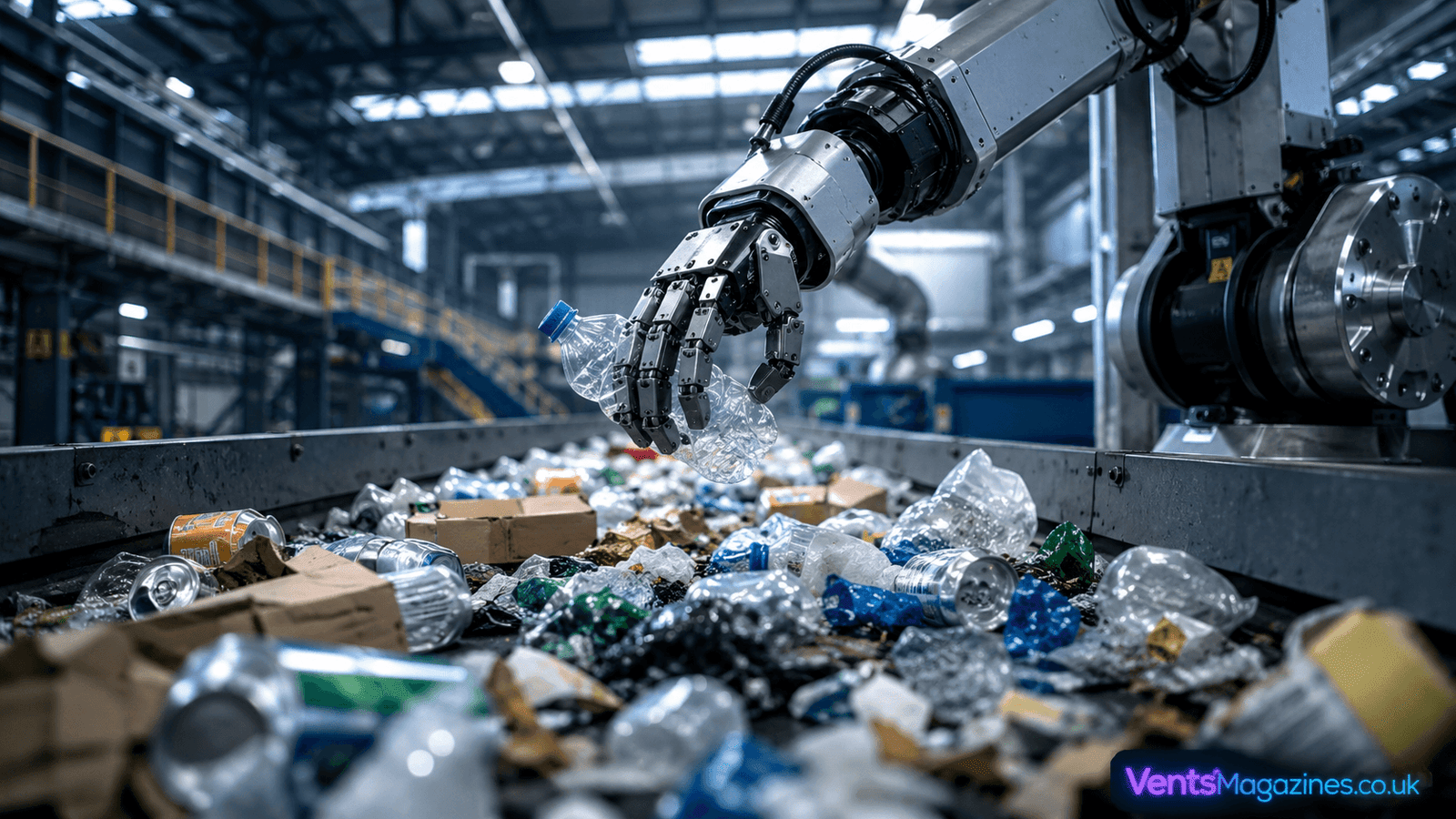
Britain’s bins hide a stubborn problem. Even where sorting technology is decades old, contamination and human error still send usable materials straight to landfill. Around the world, the numbers back that up: global waste generation hit 2.56 billion tonnes in 2022, according to the World Bank’s What a Waste 3.0 report, a level the organisation had not expected to see until 2030.
That gap between projection and reality is why AI recycling technology has moved from pilot project to mainstream infrastructure at material recovery facilities across the UK, US and Europe. Cameras, sensors and machine learning models are now doing a job that used to depend entirely on tired eyes and quick hands on a fast-moving conveyor belt.
This piece looks at how the technology actually works, what it delivers in measurable terms, and where it still falls short.
What AI recycling technology actually does
At its core, an AI sorting system pairs a camera or optical sensor with a trained model that recognises materials by shape, colour, texture and, in more advanced systems, near-infrared signature. Robotic arms then physically pick and place items into the correct stream.
Companies including AMP Robotics, Tomra and ZenRobotics have built commercial systems around this approach. AMP’s AI platform, for example, maps millions of packaging images so its robots can distinguish something as specific as a number 5 polypropylene yogurt cup, a distinction that older optical scanners routinely miss.
The result isn’t a fully automated facility with no human staff. Most sites run AI systems alongside people, using the technology to catch what manual sorting misses at speed rather than replacing the workforce outright.
Also read: Student’s Guide to AI Projects: Sharpen Your Machine Learning Skills
The accuracy gap between manual and AI sorting
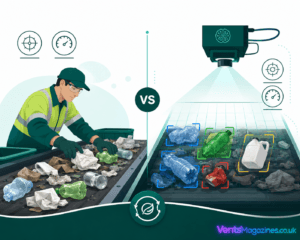
Independent testing gives a clearer picture than marketing material alone. A 2025 peer-reviewed comparison of manual and robotic sorting at material recovery facilities in Jakarta and South Tangerang found a meaningful gap in both accuracy and material purity.
| Metric | Manual sorting | AI-assisted sorting | Source |
| Sorting accuracy | 75% | 90% |
Peer-reviewed MRF study, 2025 (thesai.org)
|
| Material purity | 84.90% | 95.10% | Same study |
| Throughput | approx. 45 items/min | approx. 50 items/min | Same study |
| Best-case commercial accuracy | n/a | up to 99%, 80 to 120 picks/min |
AMP Robotics, Waste Management World interview, 2022
|
| Contamination reduction | baseline | approx. 40% lower |
Columbia Climate School, 2025
|
Figures marked approx. are averages drawn from the cited sources; commercial vendor figures represent top-end performance rather than industry-wide averages.
Commercial vendors report even stronger results under ideal conditions. AMP Robotics has said its Cortex system reaches up to 99 percent accuracy at 80 to 120 picks per minute, more than double a typical human sorter’s pace, based on deployment data reported by Waste Management World in 2022.
None of this means manual sorting disappears. Facilities still rely on trained staff for quality control, maintenance and the judgement calls that current AI models can’t make. What changes is where that labour gets spent.
Why the scale of the waste problem makes this urgent
The case for faster, more accurate sorting gets stronger once you look at where waste volumes are heading. The World Bank’s most recent projections show growth outpacing earlier forecasts by a wide margin.
| Year | Global waste generated | Source |
| 2018 (US only) | 292.4 million tons, 32.1% recycled or composted |
US EPA, Facts and Figures report
|
| 2022 (global) | 2.56 billion tonnes |
World Bank, What a Waste 3.0
|
| 2050 (global, projected) | approx. 3.86 billion tonnes under business as usual |
World Bank, What a Waste 3.0
|
Under a business as usual scenario, that would represent roughly a 50 percent increase in global waste in under three decades. The World Bank also notes that the waste sector already employs an estimated 18 million urban workers worldwide, so the transition to smarter sorting has real implications for jobs, not just tonnage.
The jobs picture is more complicated than automation fears suggest
A common assumption is that robots replace recycling workers outright. The evidence so far points the other way. Research summarised by Columbia University’s Climate School in 2025 found that incorporating AI into recycling systems has already produced a 15 percent increase in job opportunities in the sector, with projections of over 10,000 new roles globally by 2028.
Those roles tend to shift toward maintenance, equipment operation and route planning rather than manual picking on a conveyor line. For workers, that’s a change in the type of job available rather than a straightforward loss of employment.
Where AI sorting still struggles
The technology isn’t a complete fix. Soft plastics, flexible film and heavily contaminated or crushed items remain difficult for even advanced systems to identify reliably. Facilities in lower-income countries also face a basic infrastructure gap: the World Bank reports that only about 4 percent of waste in low-income countries gets recycled at all, largely because the collection and sorting infrastructure needed to deploy this technology isn’t in place yet.
Cost is the other constraint. Robotic sorting systems require significant upfront capital, and smaller municipal facilities often can’t justify the investment without external funding or a clear path to recovering the cost through better material recovery rates.
What this means for households and businesses
For most readers, the practical takeaway is simpler than the technology behind it. Cleaner separation at the household or business level, rinsing containers, keeping film plastic out of the recycling bin, still makes a measurable difference, because AI systems perform best on material streams that arrive with less contamination in the first place.
As facilities across the UK continue to invest in smarter sorting, the burden on individual households to get every category perfect may ease slightly. That said, the fundamentals of good recycling habits haven’t gone away. They’ve just gained a more capable partner on the other end of the supply chain.
The bottom line on AI recycling technology
AI recycling technology delivers a clear, measurable improvement over manual sorting alone, better accuracy, higher material purity and faster throughput, and it’s arriving at a moment when global waste volumes are climbing faster than earlier forecasts predicted. It isn’t a replacement for good waste habits or for the people who still run these facilities, but it is changing what a modern material recovery facility looks like. Anyone curious about where their own recycling ends up could start by asking their local authority whether AI recycling technology already plays a part in the process.
Frequently Asked Questions
How does AI recycling technology actually sort waste?
A camera or near-infrared sensor scans each item on the conveyor and a trained model identifies the material by shape, colour and texture in a fraction of a second. Robotic arms then physically pick the item and place it in the correct stream, all without a person touching it.
Does AI recycling technology replace human sorters?
Not in practice. Columbia Climate School reported a 15 percent increase in recycling-sector job opportunities after AI adoption, with roles shifting toward maintenance, equipment operation and route planning rather than disappearing outright.
How accurate is AI recycling technology compared with manual sorting?
A 2025 peer-reviewed study of material recovery facilities found robotic sorting reached 90 percent accuracy against 75 percent for manual sorting. Commercial vendors such as AMP Robotics report up to 99 percent accuracy under ideal deployment conditions.
Which companies build AI recycling technology?
AMP Robotics, Tomra, ZenRobotics, Glacier and EverestLabs are among the established names. Bollegraaf, the world’s largest recycling facility builder, has partnered with Greyparrot to retrofit thousands of sites with AI-enabled sorting.
Can AI recycling technology handle electronic waste?
Yes. Robotics firm Molg uses AI-enabled arms to disassemble electronics and separate valuable metals, a task that’s difficult for humans because e-waste is such a complex mix of materials.
Does AI recycling technology reduce contamination?
Yes. Columbia Climate School research found AI systems reduce contamination in recycling facilities by close to 40 percent, largely because sensors catch misplaced items that human sorters miss at speed.
How much does an AI recycling system cost a facility?
Costs vary by system and scale, but Glacier, one AI sorting provider, cites a typical payback period of under two years for its equipment. Smaller municipal facilities without external funding often find the upfront cost harder to justify.
Can AI recycling technology sort every type of plastic?
No. Soft and flexible plastics remain genuinely difficult to identify even for advanced systems. Researchers at NIST are developing infrared methods to improve detection, but current commercial systems still struggle with this category.
Does building AI recycling technology create its own e-waste problem?
It does, somewhat ironically. Research cited by Columbia Climate School projects AI’s growing hardware demands could increase global e-waste by 3 to 12 percent by 2030, roughly 2.5 million additional metric tons a year.
Will AI recycling technology become standard at facilities?
Experts cited by Columbia Climate School expect AI-enabled recycling systems to become standard in new facilities by 2030, with the sector’s AI adoption forecast to grow at roughly 22 percent a year through the decade.